How PLEA’s Indigenous Matters Committee advances Truth and Reconciliation
Written by Penny Gagnon, MA, CARF Canada Chief Accreditation Advisor.
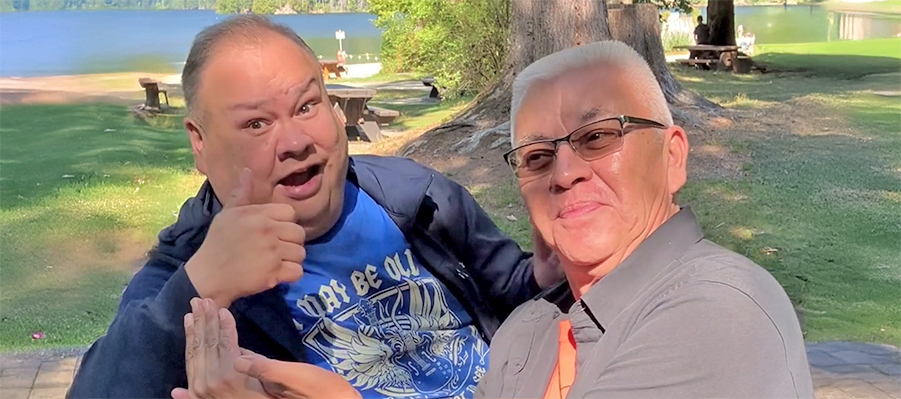
Photo Caption: Pictured above (L to R) are PLEA Knowledge Keepers Ernie Cardinal and Charles Lafferty.
For nearly two decades, PLEA Community Services, Vancouver, British Columbia, has been accredited by CARF Canada, continually demonstrating their commitment to quality and innovation in service delivery. PLEA’s vision is simple yet profound: a world where everyone has the opportunity for a good life, and everyone counts. This vision has guided the organization as it supports children, youth, adults, and families facing significant challenges, always striving to build lives of meaning and connection within their communities.
Among PLEA’s many achievements is the growth of the Indigenous Matters Committee. Recognized as a strength in PLEA’s last two CARF surveys, the committee exemplifies how reconciliation can move from symbolic gestures to meaningful change.
The committee’s journey from events to belonging started with recognizing and participating in cultural events such as National Indigenous Peoples Day, Orange Shirt Day (now known as National Day for Truth and Reconciliation), and other commemorations. Building on the important work, the committee has evolved into a powerful driver of organizational transformation, shaping policy, programs, and outcomes across the agency. “As a committee, we wanted to ask ourselves: What’s our intention? How are our values influencing what we do, and how do we tie our work directly to reconciliation?” said committee co-chair Sara Griffiths. That shift in focus marked the beginning of a deeper learning journey for the organization.
In 2021, PLEA adopted a five-year Indigenous Strategy that provided a roadmap for reconciliation. The top three priorities are: (1) to assist programs and personnel to improve knowledge, capacity, and competency in providing effective and culturally-sensitive services; (2) to develop connections and strengthen relationships with Indigenous agencies and communities; (3) to put forward recommendations and strategies for building and maintaining cultural connections for Indigenous participants. Around the same time, the organization welcomed Knowledge Keeper Charles Lafferty, who is Dene Métis with ties to the Łı́ı́dlı̨ı̨ Kų́ę́ First Nation and the NWT Métis, into a newly created role and as a committee co-chair. This role was designed with guidance from Elders and Knowledge Keepers, including Lafferty himself. “The foundation was already there when I arrived,” said Lafferty, “my role was to elevate the conversations, including looking at how colonial systems and Indigenous worldviews don’t always align, and how to navigate those differences with integrity.”
Since then, the committee has had a profound impact on operations across PLEA. The Board of Directors has been deeply engaged through attending events and learning alongside staff and participants. At one canoe awakening ceremony, a board member participated in her first smudge, guided gently by Lafferty. The ceremony involves washing the canoes in preparation for the upcoming season on the water. “She was nervous, but she trusted, and she was deeply moved,” said Griffiths. “It showed that leadership is willing to learn alongside everyone else.” Policies and procedures have also been reshaped to reflect cultural considerations, including updates to PLEA’s “Protocol in the Event of a Death” and the redesign of intake processes that involve extended family and cultural practices. Committee participation has even become a factor in staff performance reviews, reinforcing the principle that reconciliation is everyone’s responsibility.
The most visible changes can be seen in the delivery of services. PLEA’s canoe program has become a cultural centerpiece, with an annual wake-up ceremony in the spring and a putting-to-sleep ceremony in the fall. These events, rooted in Coast Salish traditions, include cedar brushing, spirit plate offerings, and shared meals. Over 100 people typically attend, including participants, staff, caregivers, board members, and community partners. For Lafferty, the meaning is clear, “The bottom line is belonging. Getting people out of their apartments, giving them a place in the community. That’s the gift of the canoe.”
Other initiatives reinforce this sense of belonging. Weekly on-the-land and outdoor programs connect participants with nature, a recognized element of healing. Cultural safety plans ensure that staff and caregivers learn about each participant’s specific traditions, languages, and foods, replacing generic “cultural goals” with individualized, meaningful supports. Caregivers and staff also receive education on the difference between cultural appreciation and appropriation, and those supporting participants from the Northwest Territories complete “Living Well Together,” a government-developed training program that builds cultural understanding.
The impact on participants has been profound. Youth who once stayed isolated in their rooms now take part in canoe journeys and on-the-land activities. Caregivers who had never before experienced traditional practices now cook side by side with participants. Residential school tours have also transformed understanding. Over 200 staff, board members, and caregivers have visited the former St. Mary’s Residential School in Mission, followed by structured debriefs to process the experience. “These moments are emotional and cathartic,” said Lafferty. “For many, it’s the first time they’ve heard the deep history. It changes how they show up every day.”
Looking ahead, PLEA’s next Indigenous Strategy will build on what has been learned over the past five years. Priorities include bringing every program to the same level of cultural integration, embedding outcomes measurement that tracks belonging and cultural safety, expanding mentorship to other organizations, and growing Indigenous staff and caregiver capacity.
“This work has to be 365 days a year,” said Griffiths, “not just around commemorative dates. And it has to be embedded in intakes, in policies, and in everyday practice.”
For organizations beginning their reconciliation journey, Lafferty offers two pieces of advice. The first is to start with the truth. “Go back to the Truth and Reconciliation Commission’s Calls to Action1. Use the free resources out there, like webinars, podcasts, and videos. And don’t rush the hard conversations,” he said. The second is to build the container. “Have a strategic plan, timelines, champions, and resources. This can’t be done off the side of a desk. It has to be resourced and intentional.”
Griffiths adds a reminder that allyship is essential and shares, “It’s not the responsibility of Indigenous peoples alone. Everyone in an agency must take responsibility, hold each other accountable, and commit to doing this in the right way.”
Both Lafferty and Griffiths say this work has changed them personally. Lafferty, whose family was deeply affected by the residential school system, says, “I’ve seen hopelessness up close. But this work gives me hope that systems can change. It’s a window to mentor, advocate, and move institutions toward reconciliation.”
For Griffiths, the pride comes from seeing strategy turn into action. “I see our strategic plan happening in real life. Staff are keen, participants feel they belong, and outcomes are improving. That makes me proud and hopeful for the future.”
The story of PLEA’s Indigenous Matters Committee represents how reconciliation is not an event or a checklist. Reconciliation is a journey of belonging, accountability, and continuous learning. As PLEA prepares its next five-year strategy, it offers a model for others, one that starts with truth, embeds reconciliation into the fabric of operations, measures what matters, and creates space where everyone belongs. In doing so, PLEA is living its vision: a world where everyone has the opportunity for a good life, and everyone counts.
Acknowledgements and contributions:
PLEA Community Services has operated throughout British Columbia for more than 40 years. It delivers community-based services and specialized homes to children, youth, adults, and families facing significant challenges in their lives. The organization offers the full spectrum of social services designed to support participants to avoid, overcome, and recover from the most complex circumstances.
It acknowledges that it is situated on the unceded traditional territories of the Coast Salish and Sto:lo Peoples, including ten local First Nations: q́ićəý̓ (Katzie), q́ʷɑ:ńƛ̓əń (Kwantlen), kʷikʷəƛ̓əm (Kwikwetlem), máthxwi (Matsqui), xʷməθkʷəy̓əm (Musqueam), qiqéyt (Qayqayt), se’mya’me (Semiahmoo), Sḵwx̱wú7mesh Úxwumixw (Squamish), scəẃaθən məsteyəxʷ (Tsawwassen), and səlilwətaɬ (Tsleil-Waututh).
CARF Canada gratefully acknowledges that its headquarters are located on Treaty 6 Territory, the traditional territories of many First Nations, including the Nehiyaw (Cree), Denesuliné (Dene), Nakota Sioux (Stoney), Anishinaabe (Saulteaux), and Niitsitapi (Blackfoot), and within the Métis homelands and Métis Nation of Alberta Region 4.
CARF Canada extends a special thanks to Charles Lafferty, Sara Griffiths, and PLEA Community Services. Their stories, knowledge, and insights made it possible to share this journey in a meaningful way.
Charles Lafferty, PLEA Knowledge Keeper, joined the organization in September 2021. He is from the Dehcho Region, located in Fort Simpson, Northwest Territories. He identifies as Dene Métis, with ties to the Łı́ı́dlı̨ı̨ Kų́ę́ (Liidlii Kue) First Nation and the Northwest Territories Métis. Today, Lafferty makes his home as a settler in Coast Salish Territory, specifically in the Musqueam, Squamish, and Tsleil-Waututh region known as Vancouver, British Columbia.
Sara Griffiths has been with PLEA for 19 years, beginning her journey with a federal FASD (Fetal Alcohol Spectrum Disorder) initiative before moving into a management role with PLEA’s specialized family care programs. As a third-generation Canadian, she has spent most of her life in New Westminster, British Columbia, where she lives with her husband. She is also a proud mother of two adult daughters who continue to inspire and motivate her every day.
- Truth and Reconciliation Commission of Canada, Calls to Action (Government of British Columbia, 2015), https://www2.gov.bc.ca/assets/gov/british-columbians-our-governments/indigenous-people/aboriginal-peoples-documents/calls_to_action_english2.pdf. ↩︎